
 larry
larryNASA’s climate satellites and Earth-observing technology have quietly become some of the most powerful tools in the fight against environmental degradation, transforming how we understand and respond to our planet’s urgent sustainability challenges. While most people associate the space agency with Mars rovers and moon landings, NASA dedicates substantial resources to monitoring Earth’s atmosphere, oceans, ice sheets, and forests from orbit, providing data that shapes everything from renewable energy policy to regenerative agriculture practices.
The connection between space exploration and sustainable living is more direct than you might expect. Technologies originally developed for astronauts surviving in space’s hostile environment have evolved into everyday eco-friendly innovations: advanced water purification systems, solar panel efficiency breakthroughs, and lightweight materials that reduce transportation emissions. NASA’s partnerships with private companies have accelerated this technology transfer, bringing space-grade solutions to consumers seeking genuine sustainability improvements.
For environmentally-conscious individuals in 2026, understanding NASA’s role means recognizing that satellite data informs the precision agriculture reducing fertilizer runoff, the climate models guiding coastal protection efforts, and the air quality monitoring protecting vulnerable communities. These aren’t abstract scientific achievements. They represent practical pathways toward a more sustainable future, backed by decades of rigorous observation and measurement.
The beauty of NASA’s contribution lies in its accessibility. The agency makes much of its Earth science data freely available, empowering researchers, policymakers, and even individual citizens to make informed environmental decisions. This open approach mirrors the transparency that defines authentic sustainable brands, creating a foundation for real progress rather than performative gestures.
From Space Missions to Sustainable Solutions

Space exploration has never been kind to waste. On a spacecraft, every drop of water, every cubic metre of air, and every gram of material must work harder than anything on Earth. NASA engineers learned decades ago that survival in the void demands radical efficiency, the kind environmentally-conscious consumers now seek in their daily lives.
That same closed-loop thinking has quietly shaped some of the most effective sustainable technologies we use today. When astronauts needed clean drinking water on long missions, NASA developed water purification techniques that have since filtered into household systems, emergency relief operations, and off-grid communities. The technology strips contaminants using minimal energy and zero chemical additives, exactly what eco-friendly living advocates look for in products that work without compromise.
Air purification followed a similar path. Spacecraft cabins can’t open a window, so NASA created filtration systems that remove volatile organic compounds, mould spores, and bacteria at the molecular level. These systems now appear in home air purifiers marketed to families seeking healthier, chemical-free indoor environments. The same principles guide brands developing natural air fresheners and ventilation solutions that prioritize breathability over masking odours with synthetic fragrances.
Resource efficiency breakthroughs extend beyond water and air. NASA’s materials research, born from the need to protect astronauts in extreme conditions, has influenced everything from insulation that cuts heating costs to lightweight composites that reduce transportation emissions. The agency’s work on solar panel efficiency, battery longevity, and thermal regulation continues to inform clean energy products entering the consumer market.
Key NASA innovations now appearing in sustainable consumer products and practices include:
- Advanced water filtration systems requiring no chemical treatment or electricity
- Molecular air purification technology removing pollutants without ozone or harmful byproducts
- Thermal insulation materials reducing energy consumption in homes and buildings
- Lightweight composites cutting fuel use in transportation while maintaining durability
- Solar cell improvements increasing renewable energy capture in smaller footprints
The beauty of these innovations lies in their refusal to ask consumers to compromise. They deliver better performance while using fewer resources, the definition of luxurious sustainability. NASA didn’t set out to green your home; they just couldn’t afford inefficiency in space. That same intolerance for waste now drives products that let you live well while treading lightly.
Earth Observation: NASA’s Climate Guardian
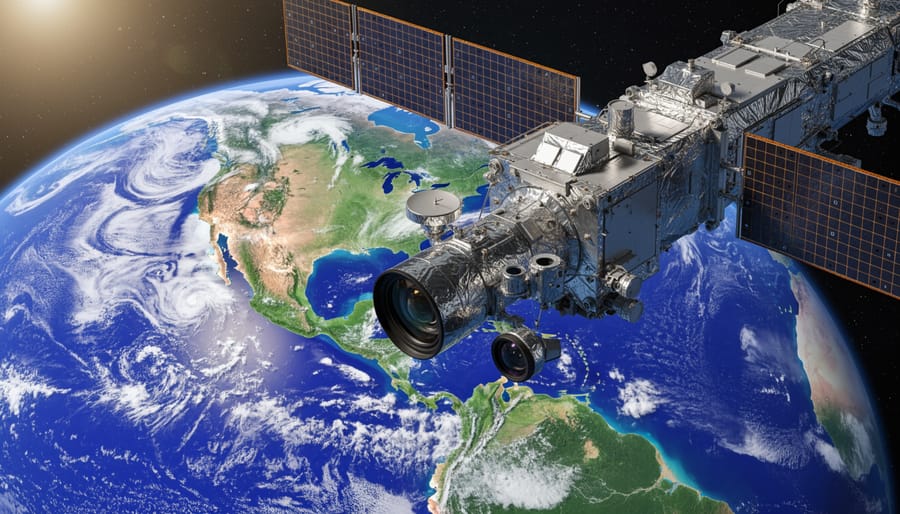
NASA’s satellite network functions as Earth’s most comprehensive environmental monitoring system, delivering data that shapes everything from international climate agreements to the choices sustainable brands make about their supply chains. These orbital observatories track changes across every ecosystem on the planet, providing the hard evidence environmental advocates need to push for meaningful action.
The agency’s fleet monitors deforestation in real time, revealing where precious forests disappear and how quickly. This data helped pressure major corporations to clean up their palm oil sourcing and gave conservation groups the proof they needed to secure protected status for threatened rainforests. Ocean health tracking shows us rising temperatures, acidification levels, and the health of coral reefs, information that informs sustainable seafood certifications and coastal protection policies.
Climate monitoring satellites measure atmospheric carbon dioxide, methane concentrations, and surface temperatures with precision impossible from ground stations alone. They also track subtle changes in Earth’s reflectivity, which scientists refer to when discussing albedo meaning and how ice loss accelerates warming. This comprehensive view reveals patterns that would otherwise remain invisible, showing us exactly where and how fast our planet is changing.
What makes NASA’s contribution particularly powerful is accessibility. Much of this data is publicly available, which means environmental organizations, researchers, and even eco-conscious businesses can access the same information that informs global policy. Sustainable brands use satellite imagery to verify their carbon offset projects actually work, tracking forest regrowth and ecosystem recovery with orbital precision rather than relying on promises alone.
This technology empowers individual environmental advocates too. When you understand that satellites are documenting every significant environmental shift on Earth, it becomes harder to dismiss climate action as abstract or uncertain. The data is there, updated continuously, showing us exactly what we’re up against and where our efforts make the biggest difference.
The Space-Sustainability Connection Growing Stronger
The conversation between space exploration and planetary stewardship isn’t happening in isolated research labs anymore. It’s moved into conference halls, academic institutions, and collaborative forums where sustainability advocates and space professionals are finding unexpected common ground.
This shift became particularly visible in early 2026 when the space conference circuit began prioritizing environmental themes. The 2026 SEDS Canadian Space Conference, a three-day event held January 23-25 at the University of Ottawa, brought together students and professionals to explore how space technology can address Earth’s ecological challenges. Just months later, the 2nd Canadian Space Launch Conference took place on May 5, 2026, at the Canada Aviation & Space Museum in Ottawa, organized by NordSpace to advance discussions around sustainable practices in space exploration and their terrestrial applications.
| Event | Date | Location | Sustainability Focus |
|---|---|---|---|
| SEDS Canadian Space Conference | January 23-25, 2026 | University of Ottawa | Student-led space innovation for environmental solutions |
| Canadian Space Launch Conference | May 5, 2026 | Canada Aviation & Space Museum, Ottawa | Sustainable launch technologies and Earth applications |
These gatherings signal a broader cultural moment. Environmentally-conscious communities are increasingly recognizing that the same problem-solving mindset that keeps astronauts alive in hostile environments, minimizing waste, maximizing efficiency, creating closed-loop systems, offers a blueprint for sustainable living on Earth. NASA’s decades of research into resource constraints and regenerative systems suddenly feels less like science fiction and more like essential reading for anyone serious about reducing their environmental footprint.
The appeal makes sense. Space agencies operate under the ultimate sustainability mandate: make everything count because you can’t afford not to. That philosophy resonates deeply with eco-conscious consumers who’ve grown skeptical of greenwashing and hungry for genuinely innovative approaches. When NASA develops a water recycling system for the International Space Station, it’s not a marketing claim, it’s survival engineering that happens to offer profound lessons for water-stressed communities back home.
Sustainable Brands Inspired by Space Technology
Beauty and Wellness Innovations

NASA’s innovations have found their way into your bathroom cabinet in surprisingly elegant ways. Several beauty brands now harness water purification technology originally developed for astronauts to create ultra-clean formulations without harsh preservatives. These filtration systems remove impurities at a molecular level, allowing companies to craft potent serums and skincare with minimal synthetic additives while maintaining stability and efficacy.
One particularly luxurious application appears in brands using NASA-inspired airless pump systems that protect active ingredients from oxidation, the same principle that keeps nutrients viable in space. This technology extends product shelf life naturally, reducing waste while delivering fresher, more effective formulas. Combined with sustainable packaging made from recycled or biodegradable materials, these products represent a genuine marriage of space-age science and environmental responsibility.
The beauty industry’s adoption of closed-loop thinking borrowed from spacecraft design means fewer resources wasted and cleaner ingredient sourcing, proving that what works in orbit can transform how we approach wellness on Earth.
Fashion’s Space-Age Sustainability
Fashion isn’t just borrowing from space technology, it’s fundamentally rethinking how clothes are made. NASA’s decades of materials research, originally designed to protect astronauts in extreme environments, has opened unexpected doors for apparel companies committed to sustainability without sacrificing quality or style.
The connection makes sense when you consider the constraints NASA engineers face. Space missions demand fabrics that are lightweight yet durable, breathable yet protective, and capable of performing flawlessly for years with minimal resources. Those same priorities align perfectly with what eco-conscious consumers want: garments that last longer, require less frequent replacement, and minimize environmental impact throughout their lifecycle.
Several innovative brands have incorporated NASA-developed phase-change materials into their collections, creating temperature-regulating fabrics that keep wearers comfortable without energy-intensive climate control. Others have adapted the agency’s research on moisture-wicking and antimicrobial textiles to produce garments that need less frequent washing, cutting water and energy use significantly. This sustainable textile movement represents luxury redefined, not through excess, but through intelligent design that delivers superior performance with reduced environmental cost.
What’s particularly exciting is how these space-age materials maintain a luxurious feel while meeting rigorous sustainability standards. Advanced insulation technologies derived from spacesuits now appear in high-end outerwear that’s warmer with less bulk, using fewer raw materials. Compression fabrics inspired by astronaut garments offer exceptional durability, meaning pieces genuinely last for years rather than seasons. When fashion looks to the stars, it finds answers that work beautifully back on Earth.
What Environmentally-Conscious Consumers Can Learn from NASA
NASA’s closed-loop approach to space station living offers a masterclass in resource efficiency that translates directly into sustainable consumption here on Earth. Astronauts can’t afford waste, so every drop of water is recycled, every scrap of material is repurposed, and every system is designed for maximum durability with minimal inputs. Bringing this mindset home means questioning whether you truly need something new or if what you already own can be repaired, upgraded, or reused in a different capacity.
The efficiency-first design philosophy NASA employs for spacecraft components can guide your purchasing decisions. Look for products engineered to last decades rather than seasons, even if they cost more upfront. A jacket built with advanced insulation technology will outperform and outlast five cheap alternatives, just as a single spacecraft component must function flawlessly for years without replacement options.
NASA’s reliance on local resource utilization in space missions translates to eating seasonal and local foods on Earth. The agency studies how to grow food using only what’s available in a specific environment because shipping supplies from Earth costs thousands per kilogram. Similarly, choosing regionally-produced goods reduces transportation emissions while supporting resilient local supply chains that don’t depend on global shipping networks.
Start tracking your household inputs and outputs the way mission control monitors a space station. Measure your water usage, energy consumption, and waste generation for one month. You’ll spot inefficiencies you never noticed, from phantom power drains to packaging waste that slips past your awareness. Small system adjustments, like switching to concentrated refills or installing low-flow fixtures, compound into significant resource savings over time.
NASA’s journey from launching rockets to launching sustainability breakthroughs offers a powerful reminder that solutions to our environmental challenges can come from unexpected places. The agency’s work monitoring our planet’s health, developing resource-efficient technologies, and inspiring eco-conscious innovation proves that looking up doesn’t mean looking away from Earth’s needs.
What makes this connection particularly exciting for environmentally-conscious consumers is the authenticity behind it. These aren’t greenwashed marketing claims, they’re battle-tested innovations born from the extreme constraints of space exploration. When brands adopt NASA-inspired purification systems or material science breakthroughs, they’re tapping into decades of research designed to make every drop of water and every gram of material count.
You don’t need a space suit to apply NASA’s lessons to your daily life. Start by thinking like an astronaut: question waste, prioritize efficiency, and invest in quality over quantity. Support brands that demonstrate genuine innovation rather than surface-level sustainability claims. The same principles that keep astronauts alive in space, closed-loop systems, precise resource management, and long-term thinking, can guide us toward a more sustainable existence here on Earth. Our planet deserves the same level of care and ingenuity we dedicate to exploring the cosmos.